
What Is a G100 Export Limitation in Commercial Solar?

Key takeaways
A G100 export limitation is a control scheme that stops your solar system sending more power to the grid than your DNO has approved.
It often decides whether a project goes ahead at its full size or gets cut back, delayed or hit with a large reinforcement bill.
The real cost isn't the equipment. It's any solar generation you lose when the limit kicks in, so this has to be in your financial model as soon as it is identified.
Sites with a demand profile that matches solar generation will typically lose very little to export, those with varying usage in daytime due to shift work or only weekday operating hours will often be more impacted.
What is a G100 export limitation?
A G100 export limitation is a control system that stops a solar installation sending more electricity to the grid than your Distribution Network Operator (DNO) has agreed. It's built to the Energy Networks Association's Engineering Recommendation G100. It lets a business install a larger system than the local network could otherwise accept, with any surplus used on site curtailed.
G100 is the Energy Networks Association engineering recommendation setting out the technical requirements for customer export and import limitation schemes. The DNO grants you an "Agreed Export Capacity", and the scheme's job is to guarantee you never go over it.
The current version, Issue 2, covers import limitation as well as export, and it was a significant revision of the earlier recommendation. The import side matters if you're adding battery storage that could charge from the grid.
Most people in the industry just say "G100" or "export limitation". You'll also see "export limitation scheme" (ELS) or "customer limitation scheme" (CLS) in DNO paperwork. They all mean the same thing.
Why do DNOs put export limits on commercial solar?
DNOs impose export limits because the local network can only absorb so much power flowing back from customer sites before voltages rise too high or cables and transformers overload. An export limit lets the DNO approve your connection without limiting your financial and timeline delays for network upgrades that full export would require.
In practice, it starts with your G99 application. Solar systems above 3.68kW on a single-phase supply, or 11.04kW on three-phase, need formal DNO approval under G99. The DNO assesses how much power the local grid can safely take from your site before deciding whether to make approval conditional on an export limitation scheme. Almost every commercial rooftop system goes through G99.
Grid capacity is tight across much of the UK. Older industrial estates are a common problem: they often have plenty of existing connection capacity for importing power but little headroom for new generation, so the DNO may grant partial export consent, such as 200kWp on a 500kWp request, or zero export.
Although there are network maps available that give an indication of the current headroom at your specific location, they are often outdated or will not reflect the actual offer you receive. This unfortunately means that the only reliable way to find out whether you will get a connection agreement, is to submit a G99 and wait for the response.
How does a G100 export limitation scheme work?
A G100 scheme measures power at your grid connection point in real time and tells your inverters to reduce output whenever export would go over the agreed limit. If any part of the scheme fails, it's designed to fail safe, holding export at or below the limit rather than letting it spike.

A typical scheme has three parts: a meter or current transformers (CTs) at the incoming supply, a controller, and the inverters it controls. The standard sets a clear performance bar. Under G100 Issue 2, the scheme must detect any excursion above the set limit and bring export back to the Agreed Export Capacity or below within 5 seconds.
The standard also closes off the obvious workaround. The export limit can only be set with engineering-level access, so the system owner can't override it, and once the scheme is commissioned, the settings are locked and can only be changed with the DNO's written agreement. Issue 2 also requires a statement from the manufacturer or installer describing how the scheme meets cyber security requirements.
Equipment choice matters here. Export limitation devices should be ENA type-tested so the DNO accepts them without a bespoke assessment. The ENA keeps a public register of type-tested equipment. An untested or bespoke scheme can add weeks to your approval.
The strictest version is a zero-export scheme. Here the DNO permits no export at all, and the site uses or stores everything it generates.
How do G98, G99 and G100 fit together?
G98 and G99 are the two routes for connecting generation to the grid, depending on system size. G100 isn't a separate route. It's the technical standard for the limitation scheme a DNO may require as a condition of a G99 approval, or that you can propose yourself to get a larger system approved.

How much does a G100 export limitation cost?
The scheme itself is usually a modest part of a commercial project budget. The larger cost is the solar generation you lose when the limit caps your output. Set that against the alternative, which can be a network reinforcement bill running from tens of thousands to hundreds of thousands of pounds and a wait of a year or more.

It helps to split the cost into three parts:
The limitation equipment and setup. For a LV connection the equipment can simply be a different meter and the introduction of CT's with the use of ENA Compliant inverters and this can be achieved in the region of £3.5k to £5k. On more complex projects with MV connections the costs increase to between "20K to £35k but can be significantly more due to the installation of the communication links between the metering location and the inverter outstations.
Application and design work. DNO fees for G99 vary widely by network and project size. [BW1] During the initial DNO/IDNO application stage there isn't any additional resource required to include an export limitation system, however the costs are incurred through technical survey and design ensuring that a compliant system is designed suitable for the bespoke installation. Generally the DNO/IDNO will require the commissioning to be witnessed and this will incur a charge which will be detailed in the grid Connection Offer.
Lost generation (curtailment). This is the big one, and the cost that's easiest to overlook. For example, a business might install a 250kWp array with a 50kW export limit, and any generation above the building's demand plus that limit is curtailed unless it can be stored. That can avoid or reduce reinforcement costs but also reduce generation revenue, so the financial model must include expected curtailment.
Now compare that with the main alternative. According to industry analysis, DNO reinforcement for a larger commercial system typically costs £50,000 to £200,000, and on constrained networks the studies and works can take 12 to 24 months.
For example: "On a food manufacturing site in Devon, the DNO offered 240kW export on a 1875kWp system. Our modelling showed curtailment of about 0.73% of annual generation, worth roughly £395 a year, against a reinforcement quote of £100k+.
What are the downsides of an export limitation?
The main downside is curtailment: when your site's demand drops and your battery (if you have one) is full, the panels are turned down and that energy is lost for good. Export limits also reduce any export income, lock in your settings, and can make it harder to expand the system later.

Here are the problems buyers should know about before they sign:
Lost generation on quiet days. A factory running seven days a week will barely notice an export limit. An office that's empty at weekends can curtail a meaningful share of its summer generation. Curtailed energy is never produced, so it can't be used, stored or exported later. Your yield estimate should already have it deducted.
Lower export income. If part of your business case relies on selling surplus power, a tight export limit weakens it. Payback periods get longer, sometimes a lot longer.
Less flexibility later. Because the settings are locked, adding panels, a battery or new loads later may mean going back to the DNO. Unless something has changed since your previous application, it is unlikely you will get a different result.
A dependency on monitoring equipment. If the scheme loses communication with its meter, it falls back to its safe state and limits output. That's the right design, but it means a faulty CT or dropped data link can quietly cut your generation until someone notices.
Oversizing risk. An installer who quotes a large system without modelling curtailment properly can make the numbers look better than they'll turn out.

As solar arrays are generating on a live and instant basis and your on site usage is typically provided in half hourly increments, it is very difficult to model the curtailment before the system goes live. Knowing the parameters does allow us to provide a very good estimate and with it, provides you the data to ensure you are making an informed decision about your risk. Without this, the actual performance or under performance as the case may be, could turn a great investment into a poor piece of procurement.
Export limitation vs reinforcement vs flexible connection: which is right for your site?
Export limitation suits most commercial sites that use most of their solar power during the day. Paying for reinforcement makes sense when full export is central to the business case and the budget and timeline can absorb it. A flexible connection suits larger, export-led projects that can accept occasional DNO-controlled curtailment in exchange for connecting sooner.

For flexible connections, one industry guide says curtailment is typically under 5% of annual generation. That varies by network, so ask the DNO for its own curtailment forecast.
Our verdict for each type of buyer:
Manufacturing, cold storage, logistics or anything running seven days a week: take the export limit. You'll use nearly all your generation on site anyway.
Offices, schools and sites that are quiet at weekends: an export limit can still work, but size the system to your weekday demand and model the weekend losses honestly.
Landlords or sites where export income is part of the case: get a reinforcement quote before you accept a limit. Sometimes it pays, often it doesn't.
Large ground-mount or very high-export projects: a G100 scheme on its own probably isn't enough. Talk to the DNO about flexible connection options, and bear in mind that grid connection queue reforms are currently changing timescales.
How can you get more value from an export-limited system?
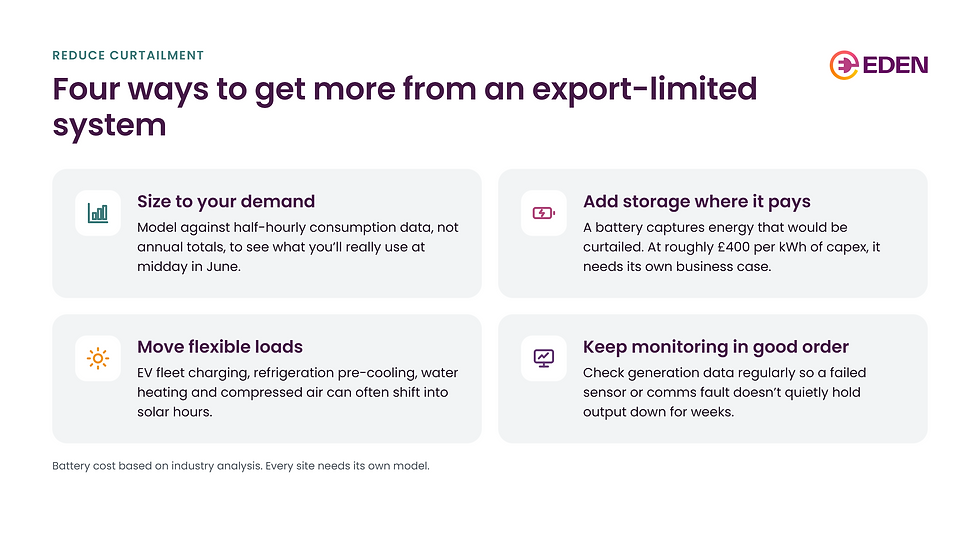
The best way to reduce curtailment is to use or store more of your solar generation on site. Battery storage, shifting flexible loads into the middle of the day, and sizing the array to your daytime demand all reduce how often the export limit actually bites.
Frequently asked questions
Does a G100 export limitation reduce how much solar power I can use on site?
No. It only limits what goes back to the grid. Your building can use as much solar power as it needs. Curtailment only happens when generation is higher than your on-site demand plus the export limit.
Can I change my export limit later?
Only with the DNO's written agreement. If you want to add panels or storage, or increase export, you'll usually need a new or amended G99 application.
Is export limitation the same as zero export?
Zero export is the strictest form of export limitation, where the agreed export capacity is set at zero. Most commercial export limits allow some export.
Do I need a battery if I have an export limit?
Not always. Sites with steady, high daytime demand often curtail very little without one. A battery is worth modelling where weekend or seasonal demand drops well below your generation.
Who applies for the export limitation?
Usually the installer, as part of the G99 application to your DNO. All they need is a signed Letter of Authority (LOA) on your letter headed paper.
Can export limitation get my project approved faster?
Often, yes. Offering a G100 scheme can avoid the need for network reinforcement, which is usually the biggest cause of delay and cost in a grid connection.
If you know that you have a constrained grid in your area, or have struggled with running a feasibility due to export limitation. Get in touch and we will be happy to help you to understand the best way forward.

